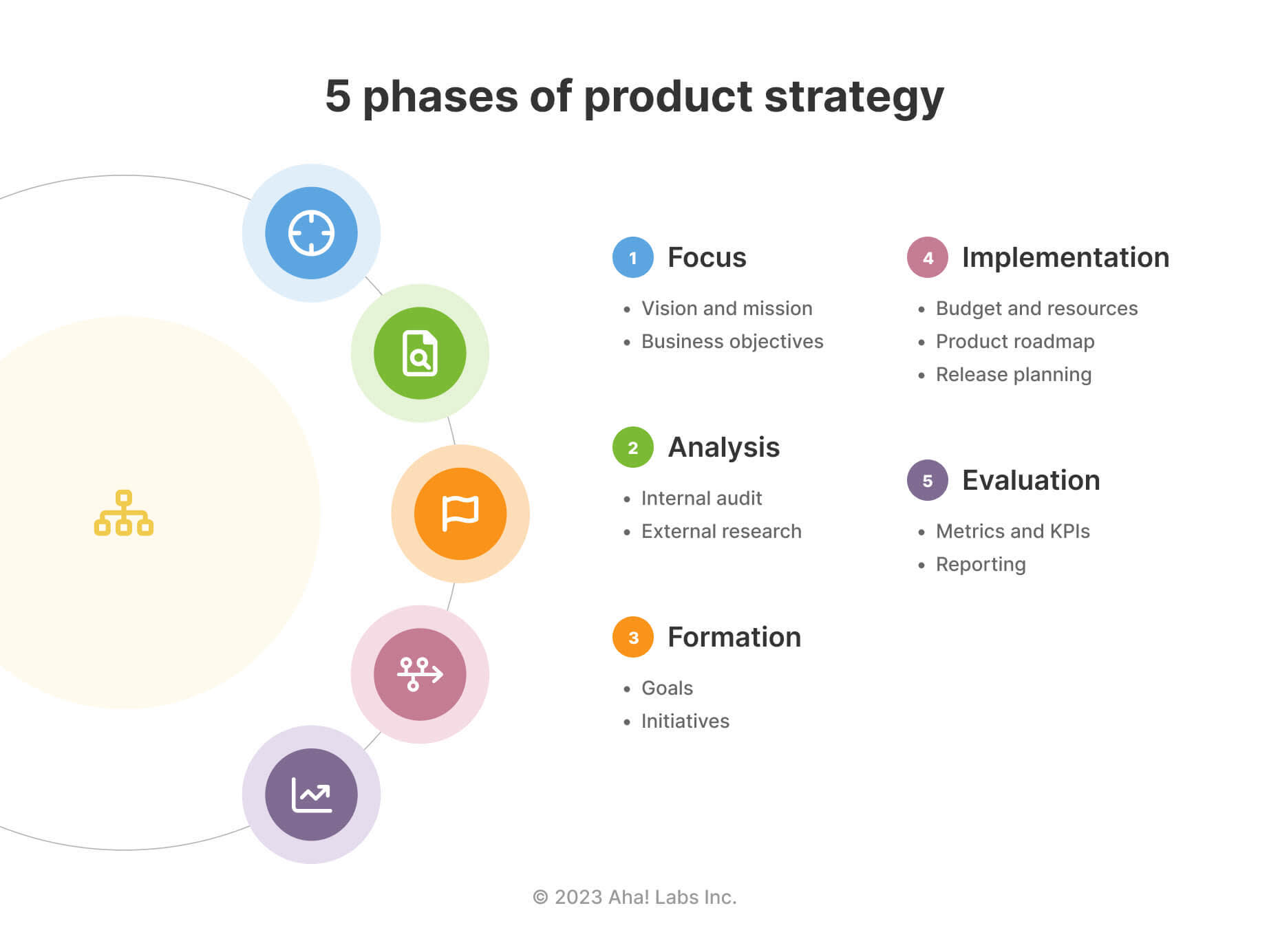
Define an effective strategy and align the team around it. Learn about documenting your overall process, defining an inspiring product vision, setting ambitious goals and initiatives, and ensuring your stakeholders are aligned.
What about differentiation?
If you have worked in product development for a while you might be wondering if we missed the “differentiation strategy.” Keen eye, but no — this is an intentional omission. The strategies above are all ways that you show why your product is different and worthy of a customer’s purchase. You cannot have a differentiation strategy, when the goal of any product strategy is to differentiate in a meaningful way.
Top
What are some tips for setting strategy?
The following 10 tips can serve as a touchstone for any product manager when setting strategy:
Do your research: Take the time to do the analysis needed to inform your product strategy, from persona work to SWOT to evaluating the market landscape.
Know your target audience: Never underestimate the power of knowing and empathizing with your customers and embrace every opportunity to deepen that knowledge.
Avoid comparisons: Do your competitive research but fend off temptations to directly compare your product one-to-one or vet opportunities against what others offer (do not let another company’s product strategy rule yours).
Be aware of weaknesses: Understand the areas where you, your team, and your product could improve.
Limit goals and initiatives: Select only three to five product goals for a given time period to prevent dilution of your efforts.
Communicate effectively with stakeholders: Make sure you can succinctly articulate the value of what you want to achieve and can translate it for different audiences.
Foster a culture of innovation: Encourage the broader product development team to use the product strategy as inspiration for their own creativity.
Embrace an agile mindset: Allow your product strategy to say “yes” or “no” to prospective features, sidestep pet projects or one-off requests that do not align, and move quickly to pursue work that does.
Keep the roadmap updated: Ensure that your roadmap shows the most recent work and reflects how that work supports the product strategy.
Continuously monitor and evaluate: Be diligent about reviewing what you have identified as supporting your product strategy, from the moment you prioritize a feature to how it performs once you release it to market.
Setting your product strategy is just the beginning. Product development is most effective when product strategy is an integral and dynamic part of the process — the lens through which all decisions are viewed.
Where AI enhances your product strategy
AI eases up the many activities included in the product development process — including powerful assistance as you set your product strategy.
A strong product strategy requires plenty of inputs. These include elements such as market knowledge, competitive analysis, customer feedback, key personas, business and stakeholder asks, past performance, and, of course, what you want to achieve. AI helps you research and synthesize these inputs faster (plus surface things you might otherwise miss).
Once the team lands on a set of goals and initiatives, use AI to stress-test the tenets of your initial product strategy from a new perspective. Once you have a solid idea of what your product strategy will look like, prompt AI to play devil's advocate. If the output reveals anything worth considering, go back and patch any weak areas of your product strategy (and keep repeating the process if necessary). This strengthens every iteration of your strategy until you land on something the entire team can sign off on.
Know that AI is not meant to create the strategy outright, though. Only you as a product manager have the judgment and deep understanding to do that well. Curious about more ways product teams can integrate AI into their workflows? Take a look at our AI prompt library for inspiration.
Related:
Top
Product strategy templates
Product development teams vary in terms of sophistication, maturity, and needs. (So do products for that matter.) In extremely early-stage companies where there might not be a product yet, you might be able to make do with researching, defining, and documenting your product strategy in Excel or PowerPoint. These tools were not built for strategy or product work though — over time you will begin to get frustrated with the limitation of using spreadsheets and presentations.
As you and your team grow in experience (or if you are already working on a complex product), you will want to choose a purpose-built tool. Integrated product management software offers all of the functionality you need to not only set strategy, but link it to active work in a dynamic way. You can prioritize features, build beautiful product roadmaps, and report on the value you delivered all in one place.
Aha! software includes everything you need to imagine, plan, build, and deliver lovable software.
Aha! templates
Guided templates in Aha! software help you capture your thoughts and collaborate with the team. Some of the most popular that product managers use to set strategy are: